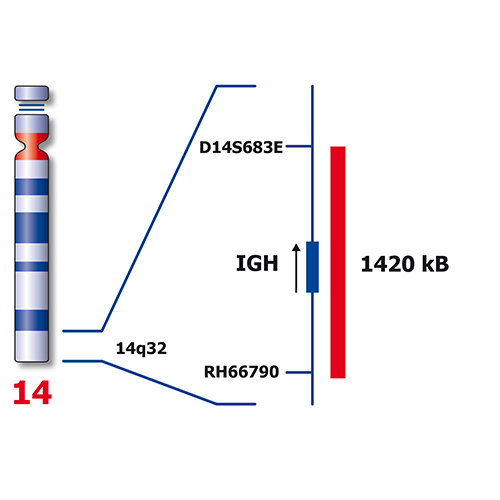
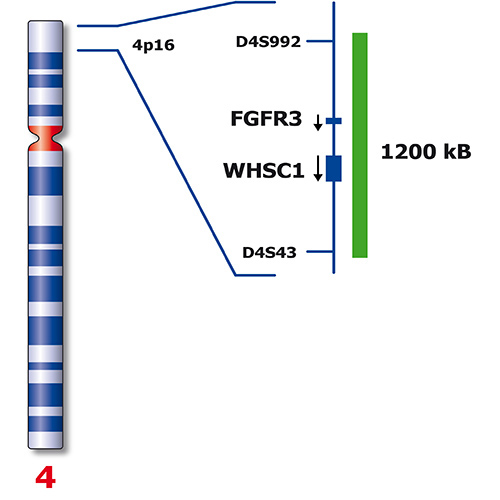
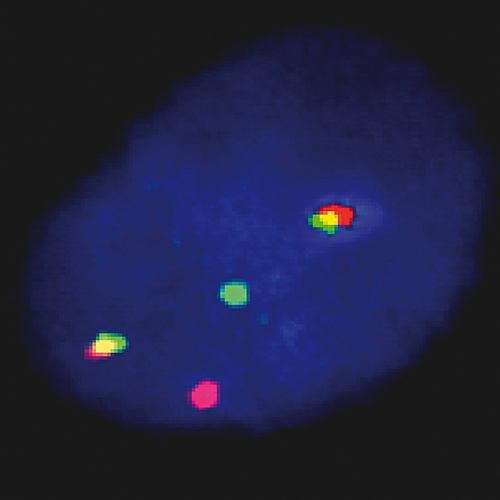
FGFR3 / IGH t(4;14) Fusion probe hybridized to MM patient material showing t(4;14) translocation (2RG1R1G). Image kindly provided by Prof. Jauch, Heidelberg.
FGFR3 / IGH t(4;14) Fusion probe hybridized to MM patient material showing t(4;14) translocation (2RG1R1G). Image kindly provided by Prof. Jauch, Heidelberg.
IVD FGFR3/IGH
The t(4;14) translocation is undetectable by conventional cytogenetics. The breakpoints on chromosome 4 occur within an approximately 113-kb region located in small part of a conserved gene cluster including the transforming acidic coiled-coil protein 3 (TACC3), fibroblast growth factor receptor 3 (FGFR3), and multiple myeloma SET domain-containing protein (MMSET). The translocation is indicative for poor survival and poor response to chemotherapy. The FGFR3/IGH t(4;14)(p16;q32) Fusion specific FISH probe is optimized to detect the reciprocal translocation t(4;14) in a dual-color, dual-fusion assay.
References: Chesi et al, 1997, Nat Genet, 16; 260-264. Finelli et al, 1999, Blood, 94; 724-732.
ダウンロード
ダウンロード
The items in your Quote cart has reached the maximum allowed items limit.
Successfully added to cart
added to cart.
No item added to cart
The replacement product is no longer available, no item has been added to cart.
If you have any questions, contact us at 1.844.534.2262

 JP
JP