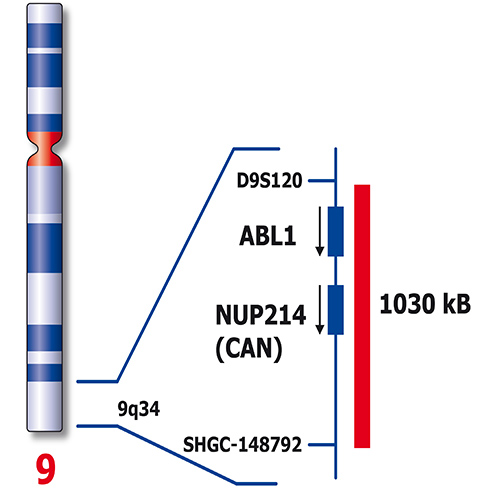
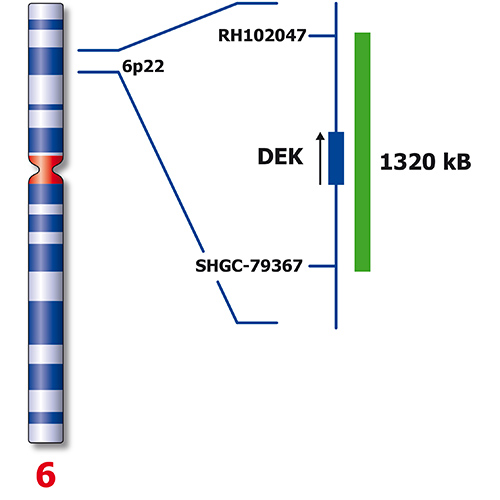
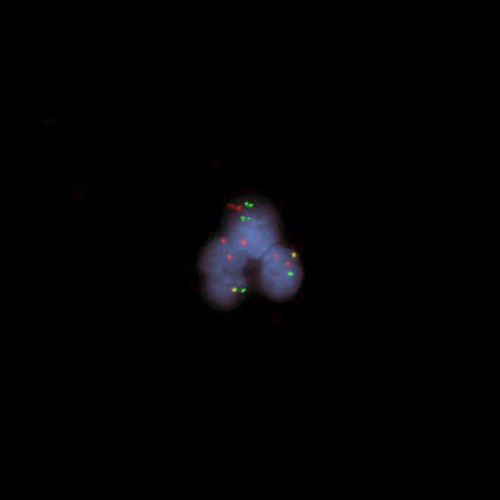
Hybridization of DEK/NUP214 Fusion Probe to a positive cell line showing a fusion due to t(6;9).
Hybridization of DEK/NUP214 Fusion Probe to a positive cell line showing a fusion due to t(6;9).
IVD DEK/NUP214
The chromosomal translocation t(6;9) (p22;q34) is associated with a specific subtype of acute myeloid leukemia (AML) and constitutes 0.5% to 4% of all AML cases. The translocation results in a fusion between the DEK oncogene (6p22) and the nucleoporin 214 kDa (NUP214 at 9q34; previously known as CAN). The exact mechanism by which the fusion protein DEK-NUP214 contributes to leukemia development has not been identified. Patients with t(6;9) AML have a very poor prognosis. The DEK/NUP214 t(6;9) specific FISH probe has been optimized to detect the reciprocal translocation t(6;9) in a dual-color, dual-fusion assay on metaphase/interphase spreads, blood smears and bone marrow cells.
References: Von Lindern et al, 1992, Mol. Cell. Biol.,12; 1687-1697. Ageberg et al, 2008, Gen. Chrom. Canc., 47; 276-287. Chi et al, 2008, Arch. Pathol. Lab. Med., 132; 1835-1837.
ダウンロード
ダウンロード
The items in your Quote cart has reached the maximum allowed items limit.
Successfully added to cart
added to cart.
No item added to cart
The replacement product is no longer available, no item has been added to cart.
If you have any questions, contact us at 1.844.534.2262

 JP
JP